Founders rarely feel busy because of one big thing. They feel fried because of a thousand tiny switches, email to Slack to Teams to calendar and back, all day. That constant hopping has a real, measurable cost, and it lands hardest on exactly the deep work a founder is supposed to be doing. Here is what the research says, and what to do about it.
What the research actually shows
Three findings, taken together, explain the founder's fried feeling:
- The switch tax. Research summarized by the American Psychological Association suggests that switching between tasks can cost as much as 40% of productive time. Your brain pays a reload cost every time it changes context.
- The 23-minute recovery. A widely cited study by Dr. Gloria Mark at UC Irvine found it takes about 23 minutes to return to a task after an interruption. A few interruptions an hour and deep focus never happens.
- The email share. The McKinsey Global Institute estimated that workers spend about 28% of the workweek reading and answering email, and that is before Slack and Teams.
Why founders pay the highest price
Two reasons. First, founders switch more than almost anyone, hopping between sales, product, hiring, fundraising and support in a single hour. Second, their most valuable work, strategy, product decisions, key relationships, is precisely the kind that needs long, unbroken focus. Context-switching does not just cost generic time; it taxes the exact resource a founder's edge depends on.
The hidden culprit: channel fragmentation
Here is the part most productivity advice misses. The problem is not that you get too many messages, it is that they arrive in too many separate places. Checking email, then Slack, then Teams, then DMs is itself a switching marathon, each app a fresh context, a fresh notification, a fresh reload. You can have a light message volume and still feel shattered purely from the hopping.
How to reclaim the focus
- Batch it. Two or three communication windows a day, not a continuous drip.
- Kill non-urgent notifications. Interruptions are the enemy; do not invite them.
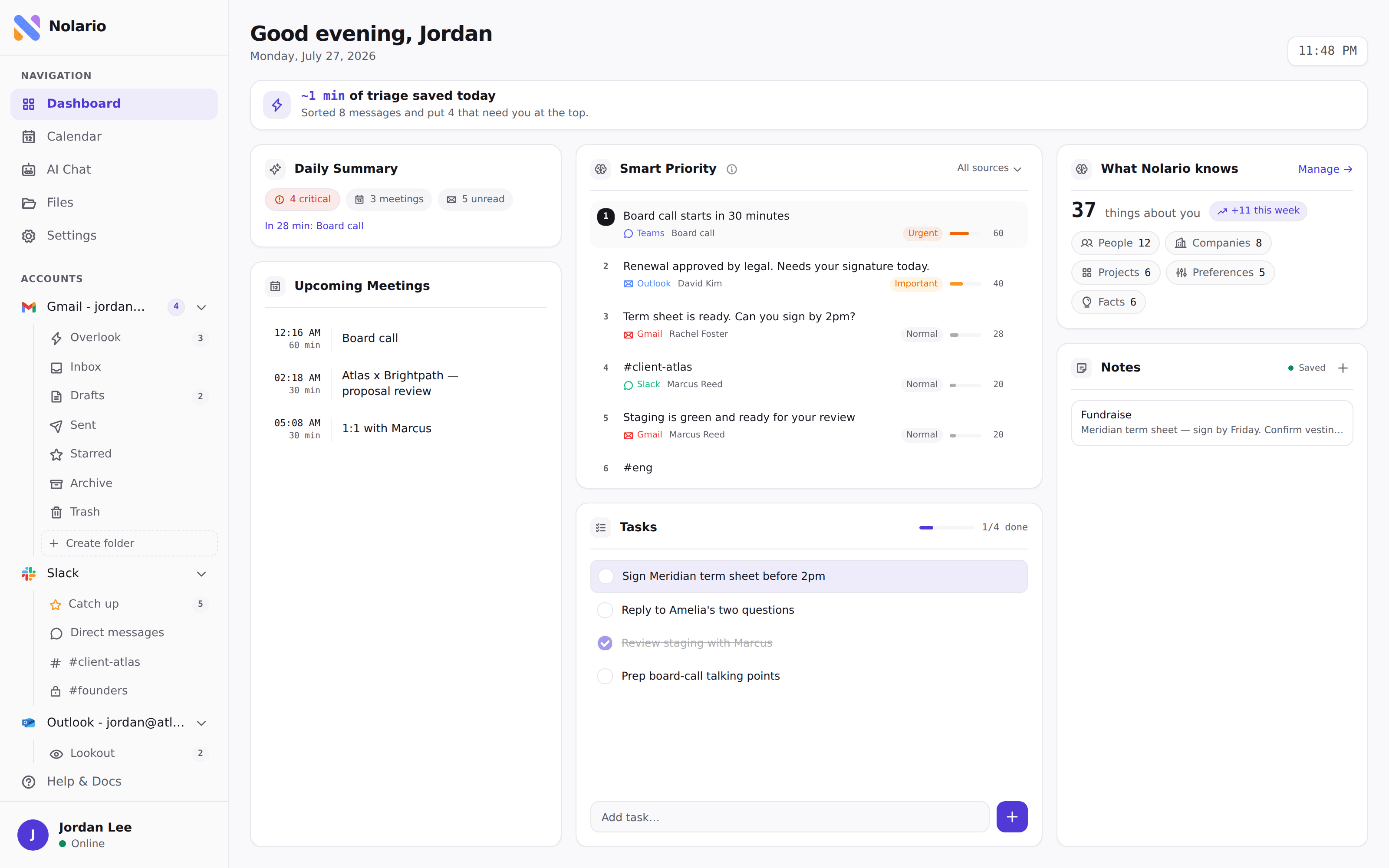
- Unify your channels. One feed for email, Slack, Teams and calendar means one triage pass instead of five, the single biggest reduction in switching you can make.
- Prioritize, do not just merge. Let AI rank the feed so your limited focused minutes go to what actually matters.
Where Nolario comes in
Nolario is built to remove the switching. It pulls every channel into one AI-prioritized feed, so instead of hopping between apps you make one pass through a ranked list, then get back to the work only you can do. Less switching, more of the 23-minute focus blocks that actually move the company forward.
