
An AI email assistant costs between about $9 and $40 per person per month in 2026, and where you land inside that range depends on one thing: whether the tool only sorts your mail or actually writes it. Filtering starts at $9.49. A tool that reads the thread and drafts the reply starts at $30 and rises. This page lists what eight of the tools people shortlist actually charge, with every figure read from the vendor's own pricing page on September 28, 2026, and it names the two that do not publish a price you can check at all.
How we ordered this list
By the monthly list price of the cheapest paid plan, lowest first. That sounds obvious and it is the only ordering that survives contact with these pricing pages, because almost every vendor advertises the annual rate in large type and the monthly rate in small type, so a list ordered by the headline number is really a list ordered by who discounts hardest. Monthly is also the price you pay on day one, before you know whether the tool is worth a year.
Six of the eight prices below were read from the vendor's own pricing page on September 28, 2026. Superhuman and SaneBox withhold their price tables from a plain page fetch, so each of those is cross checked against two independent third party pages, and where those two disagree the article says so rather than picking one. Prices are list prices at the time of writing and none of them include tax.
Mailbutler
AI writing added to the mail app you already open
Best for
Someone who will not change email client and wants drafts inside it
Price
Free plan; Professional from $9/user/mo, or $7 annual
Mailbutler is a plug in rather than an inbox, which is why it is the cheapest thing on this page. It runs inside Apple Mail, Gmail and Outlook, and its AI, which it calls the Smart Assistant, sits on the paid tiers: Professional at $9 per user per month or $7 billed annually, Smart at $14 or $11, and Business at $32 or $24.
The free Starter plan is genuinely permanent and genuinely limited: it stamps a Mailbutler watermark on your email and leaves the AI above it. The 14 day trial opens all features with no card. For privacy, Mailbutler states that email addresses are replaced with dummy variables before content is sent to OpenAI for the Smart Assistant, which is a narrower promise than it sounds and worth reading next to the private AI email assistants comparison.
SaneBox
Filing, not writing
Best for
Anyone who wants less mail in the inbox and no new app
Price
From $9.49/mo for the Snack plan
SaneBox is the oldest answer in this category and still one of the cheapest. It moves mail out of the inbox into folders it learns from your behaviour, and it works with Gmail, Outlook, Apple Mail, Fastmail, Yahoo, AOL and any IMAP or Exchange account, which is a wider reach than anything else here. Snack is $9.49 a month, Lunch $15.99 and Dinner $42.99, with a 7 day trial.
It does not draft. If what you want is fewer messages rather than faster answers, this is the cheapest honest option, and the SaneBox alternatives page covers what you give up by staying. Note that sanebox.com does not serve its price table to a plain fetch, so the figures above come from two independent pages that agree on the monthly rate and disagree on the annual one, which is why no annual figure appears here.
Missive
A shared inbox with AI attached
Best for
A small team answering one mailbox together
Price
From $14/user/mo, no free plan
Missive prices in three steps: Starter at $14 per user per month for up to 5 users, Productive at $24 for up to 50, and Business at $36 with no user cap. Yearly billing is advertised at 20 percent off. The trial is the most generous on this page at 30 days of the Productive plan with no card, and there is no permanent free plan.
The price buys collaboration more than intelligence: shared inboxes, internal chat beside the thread, assignment and rules. If you are one person, you are paying for a team feature set you will not open. See the Missive alternatives page for the single player options.
Front
A support desk that runs on email
Best for
A team with a queue, an owner per conversation and a response target
Price
From $25/seat/mo, one channel type only
Front is the clearest example on this page of why a headline price misleads. Starter is $25 per seat per month and caps you at 10 seats, and it covers a single channel type: email, or Front Chat, or SMS. The moment you want more than one, you are on Professional at $65 per seat per month, and Enterprise is $105. Annual billing saves 24 percent and the 14 day trial gives you Professional features with no card.
So the real entry price for a team that wants email plus another channel is $65 a seat, not $25. That is not a trick, it is a different product: Front is built around assignment and SLAs, which nothing else on this list does. The Front alternatives page has the cheaper shapes.
Nolario
One ranked feed for every channel, with replies drafted in your voice
Best for
Founders whose urgent messages hide across Gmail, Outlook, Slack and Teams
Price
€29/mo (waitlist)
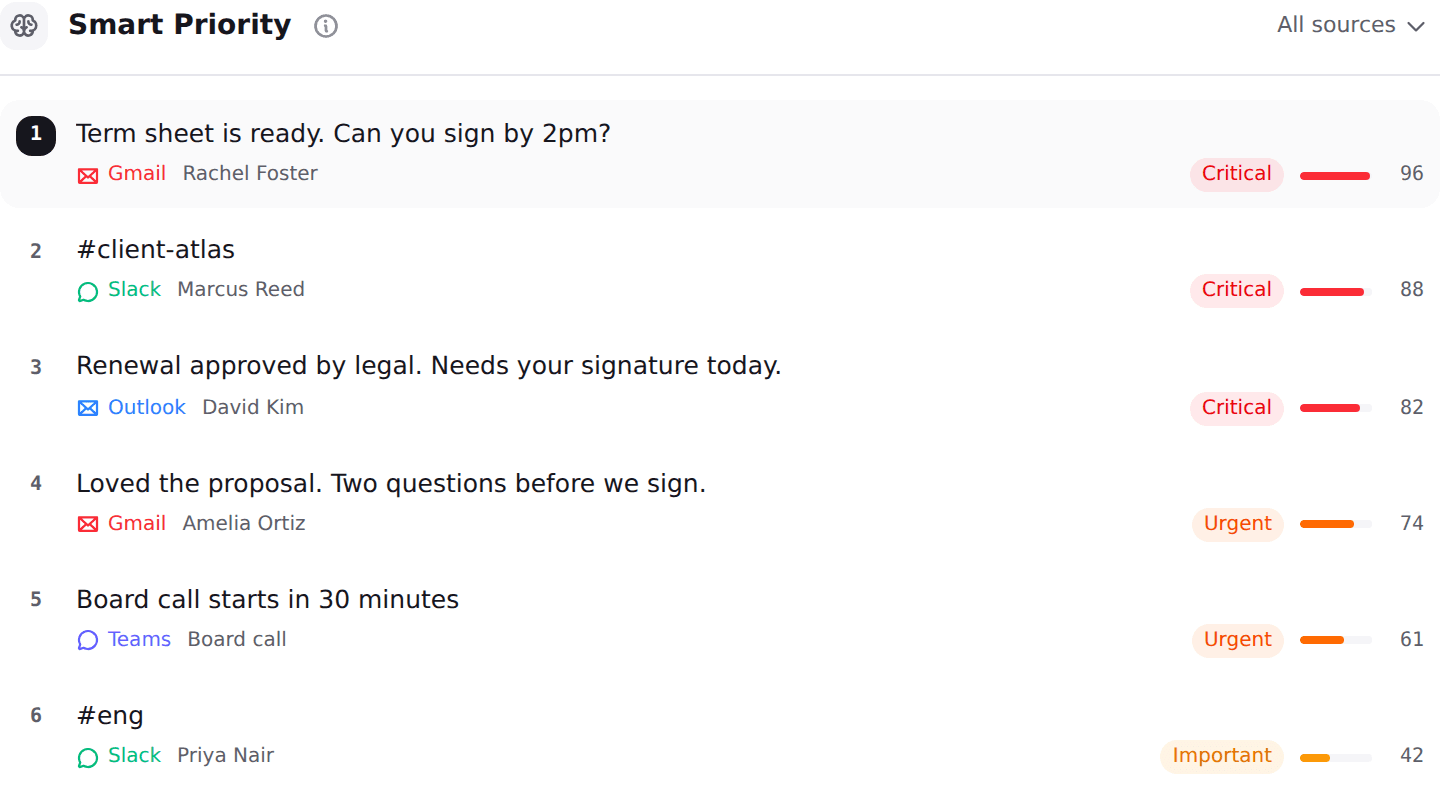
Nolario pulls Gmail, Outlook, Slack, Microsoft Teams, Google Calendar and any IMAP mailbox into one feed, scores every item for importance, ranks the feed so the thing that needs you is at the top, and drafts replies in your own voice learned from what you actually send. It ranks and it drafts. It never answers for you and it never sends.
It sits here because €29/mo is what it costs, not because it is the best buy at that price today: it is a desktop web app with no mobile app, there is no shared queue and no assignment, there is no free tier, and access is by waitlist rather than a card, so you cannot start this afternoon. See the integrations and pricing pages for what is included.
Fyxer AI
Labels the inbox overnight and leaves drafts waiting
Best for
Someone who wants replies written for them and wants to start today
Price
$30/user/mo, or $22.50 billed annually
Fyxer is the reference price for the drafting half of this category. Starter is $30 per user per month, or $22.50 billed annually at a 25 percent discount, Professional is $50 or $37.50, and Enterprise is quoted individually with a 50 user minimum. The trial is 7 days and there is no free plan.
The pricing page names Gmail and Outlook, calendar management and a HubSpot integration, and Fyxer joins video meetings to take notes. It is the tool most people on a shortlist compare everything else against, which is why the Fyxer alternatives page exists.
Shortwave
An AI layer over Gmail
Best for
A Gmail or Google Workspace user who wants AI search and summaries
Price
$30/seat/mo for Business, no annual price published
Shortwave charges $30 per seat per month for Business, $45 for Premier and $120 for Max, with a 14 day trial. Its pricing page publishes monthly rates only, with no annual figure shown at all, which makes it the one tool here you cannot compare on an annual basis.
It also has no free plan, which matters because it used to, and plenty of pages written earlier in 2026 still describe one. If you arrived from an article promising a free Shortwave tier, that is the change you are looking for, and the Shortwave alternatives page covers where people went. Shortwave is Gmail and Google Workspace only.
Superhuman
Speed first, with AI added later
Best for
Someone who works the keyboard and will pay for latency
Price
About $25 to $40 per user per month, not published in readable form
Superhuman is last because it is both the most expensive monthly entry and the only tool here whose price we could not read from its own site: superhuman.com/pricing returns its page title and nothing else to a plain fetch. Two independent pricing explainers fill the gap and they do not agree. One, published in April 2026 with its figures verified in May, says the standalone tier is gone for new users and that email now comes through a Business plan at $33 per member per month annually or $40 monthly, bundled with Grammarly and Coda. The other, published in July 2026, says a standalone Starter plan is still sold at $30 a month or $25 annually.
Both can be true at different moments, which is the point: budget for $40 a month, check what you are actually offered at signup, and read the Superhuman alternatives page before you commit to a bundle you only wanted one third of.
Monthly versus annual: the discount that decides the headline
Four of the eight publish an annual discount and all four land in the same narrow band: Fyxer and Mailbutler take 25 percent, Front takes 24 percent and Missive takes 20 percent. That consistency is what makes quoted prices for this category so unreliable. A page that writes "Fyxer costs $22.50" and "Front costs $25" is comparing an annual rate with a monthly one, and the two tools are actually $30 and $25 on the same terms.
There is a second trap underneath it. The cheapest plan is frequently not the plan that does the thing you came for. Front's $25 seat covers one channel type. Mailbutler's free plan excludes the AI. SaneBox's Snack plan files mail and writes nothing. When you compare, compare the cheapest plan that does the job, not the cheapest plan.
AI email assistant pricing compared
| Nolario | Fyxer AI | Shortwave | Front | |
|---|---|---|---|---|
| Cheapest paid plan, monthly list price | €29/mo (waitlist) | $30/user/mo | $30/seat/mo | $25/seat/mo |
| Permanent free plan | ||||
| Free trial before paying | Waitlist, no trial | 7 days | 14 days | 14 days |
| Cheaper annual rate published | ||||
| Seat cap on the entry plan |
Why the prices you find in search results are often wrong
This is not a small problem and it is easy to demonstrate. Preparing this page we read two independent third party explainers for SaneBox, both recent, both careful, both stating the date they read the vendor page. They agree exactly on the monthly rates and they disagree on the annual rates by a factor of nearly two. We read two more for Superhuman and they disagree about whether a standalone plan exists at all.
The mechanism is simple. When a vendor does not serve a price a crawler can read, comparison pages fill the gap from whatever they saw once, then other pages copy those pages, and the number outlives the price. Add a category that changed its pricing repeatedly this year, including Shortwave removing a free plan and Notion shutting Notion Mail down entirely in September, and a nine month old figure is simply fiction. If you are shortlisting, open the vendor's pricing page yourself and note the date, the same way the best AI email assistants for founders comparison does.
What you get at each price point
Free. A watermark, a trial clock or a feature set with the AI removed. The one genuinely free thing worth knowing about is what your provider already gives you inside Gmail or Outlook, which the free AI email assistants page covers properly.
Under $15 a month. One narrow job done well. Filing at SaneBox, writing assistance inside your existing client at Mailbutler, a shared mailbox for a tiny team at Missive. None of these decides what matters.
$25 to $40 a month. The judgement tier. This is where a tool reads the thread, decides whether it needs you, and has a draft ready before you open it. Fyxer, Superhuman, Shortwave and Nolario all live here, and the differences between them are about which channels they can see rather than what they charge.
Above $60 a seat. Team infrastructure. Queues, assignment, SLAs, audit. If one person is paying this, they have bought the wrong product; see email management software for the split between personal and team tools.
Where Nolario fits
Nolario is priced in the judgement tier at €29/mo, and on price alone it is unremarkable: it sits between Front's entry seat and Fyxer's. What the money buys that the others at this level do not is breadth. Fyxer and Shortwave and Superhuman all rank and draft inside email; Nolario does it across Gmail, Outlook, Slack, Microsoft Teams, Google Calendar and any IMAP mailbox, so the urgent thing in a Slack channel is ranked against the urgent thing in your inbox rather than living in a separate app.
It is the wrong buy in three clear cases, and they are worth stating plainly. If you need a team queue with assignment and an SLA, buy Front and accept the $65 seat. If all you want is less mail, SaneBox does that for a third of the price. And if you need something running this week, buy any of the other seven, because Nolario's access is by waitlist and the product opens through 2027. If breadth is the thing you keep failing to solve, the AI assistants that cover Gmail, Slack and Teams comparison is the shorter list to read next.
